Last Updated: October 30, 2026
Quick Summary
The residential repiping timeline for homeowners usually totals 2-4 working days for a small home with one bath, 4-6 days for an average home with two baths, and 6-10 days for a large home with three or more baths. Plumbing work is typically completed in a matter of days, with wall repair and cleanup adding separate time.
- PEX-A piping installs faster than copper because it bends around corners and needs fewer fittings.
- Water is typically restored at the end of each workday during installation.
- Walls should not close until the new system passes pressure testing and inspection.
- Drywall patching and painting often involve a different trade and extend beyond the plumbing work.
- Ask your plumber to identify the pressure-test and inspection day in advance.
Table of Contents
- How Long Does It Take to Repipe a House? Realistic Ranges
- Timeline by Home Size and Number of Bathrooms
- The Whole-House Repiping Process, Phase by Phase
- Preparing for a Whole-House Repipe: Your Pre-Project Checklist
- Water Shutoff During Repiping: What to Expect Day to Day
- What Causes Delays and How to Reduce Them
- Planning Your Residential Repiping Project with Hydroworks Plumbing
- Frequently Asked Questions
How Long Does It Take to Repipe a House? Realistic Ranges
The plumbing work on a whole-house repipe is usually completed in a matter of days, with additional time needed for wall repair and cleanup. The residential repiping timeline for homeowners stretches longer when permits, inspections, or drywall patching land on the schedule. Whole House Repiping Cost covers what the project will cost.
Here is the part most guides get wrong: the pipe work is rarely the slowest step. Waiting on an inspection slot or a drywall crew often adds more days than the installation itself.
Below, we break the project into stages so you can plan around realistic timing.
Timeline by Home Size and Number of Bathrooms
Bigger homes and more bathrooms mean more pipe runs, more wall openings, and more time. A compact home with one bath moves fast. A large house with three or four baths takes considerably longer.
| Home Profile | Plumbing Days | Restoration Days | Total Working Days |
|---|---|---|---|
| Small home, 1 bath | 1-2 | 1-2 | 2-4 |
| Average home, 2 baths | 2-3 | 2-3 | 4-6 |
| Large home, 3+ baths | 3-5 | 3-5 | 6-10 |
Layout matters as much as square footage. A sprawling ranch with a long pipe run can take longer than a tighter two-story home.
Timeline by Pipe Material: PEX vs. Copper
PEX-A piping installs faster than copper. It bends around corners, needs fewer fittings, and joins with expansion tools instead of open-flame soldering. That cuts labor hours on most jobs.
Copper pipes take longer to cut, fit, and solder. The work is durable and proven, but it is slower.
- PEX-A: fewer joints, faster routing, less wall damage
- Copper: more labor, more precise fitting, longer install window
The Whole-House Repiping Process, Phase by Phase
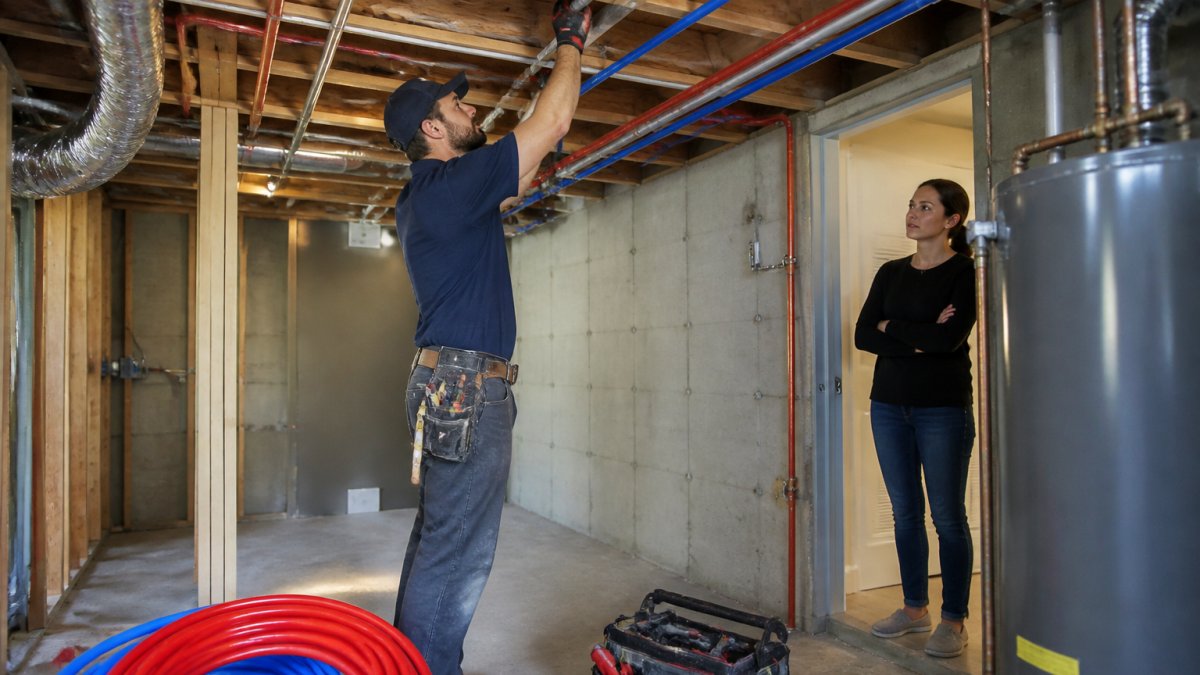
The whole-house repiping process runs through a set sequence: planning, prep, shutoff, installation, testing, restoration, and a final walkthrough. Each phase has its own clock. Below is a general day-by-day schedule for a typical two-bath single-family home, followed by the milestones that matter most to homeowners. Repiping Vs Spot Repair explains when a smaller fix is the better option.
A Day-by-Day Homeowner Schedule
Before the work begins. Planning steps typically include inspecting the system, mapping pipe routes, and handling the permit application. Permit review times vary by jurisdiction. Use this window to clear closets, cabinets, and basement corners along the planned pipe runs and to confirm parking and equipment access.
Day 1, Arrival, protection, and shutoff. The crew arrives, lays floor protection, and stages tools and materials. The water is shut off at the main while the crew opens the first access points and begins removing old pipe. Water is typically restored at the end of the workday.
Days 1-3, Installation. New pipe is routed through planned wall openings. Rough-in timing depends on the home’s layout and the pipe material used.
Pressure testing and inspection. Before any wall is closed, the new system is pressure-tested to confirm there are no leaks at fittings or joints. The local code inspector then reviews the rough-in. Walls should not close until the inspection passes. Inspection scheduling can affect the overall timeline.
Flushing and fixture check. The crew flushes the lines to clear debris, reconnects fixtures, and confirms that every faucet, toilet, and appliance has working supply and proper flow.
Restoration. Drywall patching, taping, mudding, sanding, and painting follow on a separate schedule and often involve a different trade. Larger openings need drying time between coats. Plan for restoration to extend beyond the plumbing work.
Final walkthrough. The plumber and homeowner review the completed work, confirm the inspection sign-off, and document any punch-list items.
Ask your plumber to identify the pressure-test and inspection day in advance, since that timing often determines when walls can close.
Preparing for a Whole-House Repipe: Your Pre-Project Checklist
Preparing for a whole-house repipe is mostly about clearing access and setting expectations. A little prep work can help keep the project moving.
- Clear closets, cabinets, and basement corners near pipe runs
- Move furniture away from walls that will open
- Plan parking and a clear path for equipment
- Set aside a water-free block for shutoff days
- Confirm permit status with your plumber
- Agree on a daily start and stop time
- Note any fixtures you want replaced during the job
A common mistake is leaving stored items in the way. Every hour a crew spends moving boxes is an hour not spent on pipe replacement.
Water Shutoff During Repiping: What to Expect Day to Day
Water shutoff during repiping is typically done in short blocks rather than as a continuous outage. The bigger question for most families is not the water itself but how the project fits around daily life. Here is what to plan for.
Can You Stay Home During a Repipe?
Whole-house repiping is often not a vacate-the-premises project, though that depends on the layout and the plumber’s sequencing. Ask up front which bathroom will stay in service and on which days.
Some homeowners choose to be away during the heaviest installation days, not because it is required, but because of noise, dust, and the constant in-and-out of crew members. If you work from home, plan for the loudest days (demo and rough-in) to be the least productive for calls.
Planning Around Children, Pets, and Accessibility
- Children: Keep kids and their toys out of work zones. Open wall cavities and tools are the main hazard, not the water.
- Pets: Confine pets to a room away from the work area, and ask the crew to keep exterior doors closed. Strangers, noise, and open doors are the usual stress points.
- Accessibility needs: If anyone in the household relies on a specific bathroom or a walk-in shower, tell the plumber before scheduling so that fixture stays in service as long as possible.
- Medical or mobility equipment that uses water should be flagged in advance so the crew can prioritize restoring that line.
Daily Water Schedule
The water supply may be off for part of the day on installation days. Plan around it:
- Fill pitchers and buckets the night before
- Do laundry and dishes ahead of shutoff days
- Keep a backup plan for a day or two without water
- Ask your plumber about the daily shutoff schedule
Do not assume water will be back on at a fixed hour. Shutoff windows shift when a crew hits an unexpected fitting or a slow pressure test. Build a one- to two-hour buffer into any plans that depend on water.
Service interruption is a common concern for families. Ask for the schedule up front so you can plan around water-free days and the pressure-test day.
What Causes Delays and How to Reduce Them
Delays can come from several sources, including permit review, inspection scheduling, hidden pipe problems, and restoration work. Early planning can help reduce some of them.
- Permit backlogs: submit early and confirm the review window
- Inspection slots: book the pressure test inspection as soon as installation nears completion
- Hidden corrosion or leaks: ask for a scope review before work starts
- Drywall and patching: line up the restoration crew before installation ends
A pre-project inspection can help identify problems such as corrosion or low water pressure before installation begins.
Planning Your Residential Repiping Project with Hydroworks Plumbing
Planning a residential repiping project starts with an honest timeline and a clear scope. That is the conversation we have with every homeowner before work begins.
Our licensed and insured team provides upfront cost information before work begins. We use modern equipment and proven methods to diagnose problems accurately and aim to improve water pressure and water quality.
For more on repiping, contact Hydroworks Plumbing for a quote tailored to your home.
Frequently Asked Questions
How long does repiping a house take from start to finish?
Repiping timelines vary with home size, number of bathrooms, and pipe material. Larger homes with multiple bathrooms generally take longer. Wall patching and cleanup follow the plumbing work, and the overall schedule also includes planning, permit approval, and a final inspection.
Can you stay in your home while it is being repiped?
Many homeowners remain in the home during a whole-house repipe, though water shutoffs and noise are typical while walls are opened. Clear a bathroom and kitchen area the crew can access, move valuables away from work zones, and keep some water on hand. If your home has only one bathroom, ask your plumber about options during the project.
Will the water be shut off during repiping, and for how long?
Water is typically shut off during key phases of a repipe. Ask your plumber for the shutoff schedule before work begins so you can plan meals, showers, and any home business needs around it.
What factors affect a home repiping timeline?
Home size, number of bathrooms, and pipe material matter most. Other factors include whether pipes are concealed in walls or slabs, how much drywall patching is needed, permit and inspection scheduling, and unexpected finds like corrosion damage or old galvanized steel sections. Clearing access to closets, the basement, and the attic before the crew arrives helps keep the schedule on track.
A repiping project rewards homeowners who plan ahead and ask hard questions up front. If you want a realistic schedule and a straight answer on scope, Hydroworks Plumbing is ready to help. We offer 24/7 emergency service, upfront cost information, and clear recommendations built on accurate problem diagnosis. Get started with Hydroworks Plumbing and put your repiping timeline on solid ground.