Last Updated: November 2, 2026
Quick Summary
A fair slab leak repair estimate is a written, line-item document that separates diagnosis from repair, names the access method, and states what happens if the leak turns out to be somewhere else. It should itemize detection, access, repair, and restoration as separate lines so you can audit the scope instead of reading only the bottom line.
- If three or more checklist lines are missing, you are looking at an incomplete bid.
- Slab leak repair cost is driven by access, not by the pipe itself.
- A quote with a single lump sum and no restoration line is the most common way homeowners pay twice.
- An estimate pricing only one method without explaining why the others were ruled out is a sales pitch.
- Homeowners insurance typically covers resulting water damage, not the pipe repair itself.
Table of Contents
- What a Fair Slab Leak Repair Estimate Actually Contains
- Slab Leak Repair Cost: How the Numbers Break Down
- Under Slab Plumbing Repair Cost by Method
- How to Verify the Diagnosis Before You Approve Demolition
- What a Slab Leak Repair Cost Calculator Can and Cannot Tell You
- Does Homeowners Insurance Cover Slab Leak Repair?
- Warranties, Permits, and What the Estimate Leaves Out
- Comparing Two Estimates Without Getting Played
- Requesting a Written Estimate From Hydroworks Plumbing
- Frequently Asked Questions
What a Fair Slab Leak Repair Estimate Actually Contains
A fair slab leak repair estimate is a written, line-item document that separates diagnosis from repair, names the access method, and states what happens if the leak turns out to be somewhere else. A single lump-sum number tells you nothing about whether you are being treated honestly. The estimate is not a price tag. It is a scope of work you can audit.
Most homeowners read the bottom line and stop. That is exactly where the trouble starts.
The Line-Item Checklist to Compare Against
Every credible estimate should itemize these separately:
- Leak detection method and fee (electronic, pressure test, or both)
- Confirmed leak location, described in plain terms
- Access method: spot excavation, reroute, or lining
- Concrete cutting, removal, and patching allowances
- Flooring removal and replacement responsibility
- Pipe material and fittings specified by type
- Labor hours or a stated flat rate
- Permit and inspection fees, listed separately
- Restoration scope and who performs it
- Warranty terms on labor and materials
If three or more of those lines are missing, you are looking at an incomplete bid. Ask for them in writing before you compare anything else.
Slab Leak Repair Cost: How the Numbers Break Down
Slab leak repair cost is driven by access, not by the pipe itself. The pipe is cheap. Finding it, reaching it, and putting your floor back together is where the money goes. A fair estimate prices each of those stages separately so you can see which one is inflating the total.
A useful way to think about any quote is to split it into four buckets: detection, access, repair, and restoration. The pipe and fittings are often a small fraction of the total, while access and restoration can dominate. That is why two bids for the same leak can differ by thousands without either contractor being dishonest, they are pricing different amounts of concrete and flooring work.
What Each Bucket Typically Covers
Detection. A diagnostic visit that includes an electronic listening device, a pressure test, or both. This is usually a fixed fee, and it should be credited or applied toward the repair if you authorize the work. Ask whether the fee is separate from the repair estimate or rolled into it.
Access. Concrete cutting, breaking, hauling, and patching. This bucket scales with depth, slab thickness, and whether the slab is post-tension (which requires locating and avoiding tension cables before any saw touches concrete). Access under tile, hardwood, or a finished basement floor costs more than access under bare garage concrete because the finish has to come up first.
Repair. The pipe work itself: cutting out the failed section, fitting new pipe, pressure-testing the joint, and backfilling. This is where the method choice, spot repair, reroute, or lining, shows up in the price.
Restoration. Patching the concrete, then replacing flooring, baseboard, and any drywall opened for a reroute. Restoration is frequently the largest single line and the one most often omitted from a low bid.
Reading the Buckets Against a Bid
When you scan a quote, check whether each bucket appears as its own line. If detection and repair are bundled into one number, you cannot tell whether you are paying for a thorough diagnosis or a guess followed by a jackhammer. If restoration is missing entirely, the bid is not cheaper, it is incomplete, and the missing cost will reappear later.
Watch out: a quote that lists a single lump sum with no access or restoration line is the most common way homeowners end up paying twice, once for the repair and again for the floor.
Use the line-item checklist above as the audit tool for these buckets. Every bucket should map to at least one checklist line, and every checklist line should map to a bucket. If a line has no home, ask why it is there. If a bucket has no line, ask what it will cost.
Under Slab Plumbing Repair Cost by Method
Under slab plumbing repair cost varies most by which method the contractor chooses, and the cheapest method is not always the least expensive outcome. Three approaches dominate: spot repair, rerouting, and epoxy lining. Each carries a different mix of demolition, labor, and long-term risk, and a fair estimate should state which method it prices and why.
Spot Repair, Rerouting, and Epoxy Lining Side by Side
| Method | How It Works | Best For | Main Trade-Off | What Drives Its Price |
|---|---|---|---|---|
| Spot repair | Cut concrete at the leak, replace the damaged section | Single isolated failure, sound pipe elsewhere | Leaves the rest of the old line in place | Access depth, slab thickness, flooring removal, patch and restore |
| Reroute | Run new pipe through walls or attic, abandon the buried line | Repeated failures, corroded older systems | Interior work and longer runs | Labor hours, drywall and finish repair along the new run, abandoning the old line |
| Epoxy lining | Coat the inside of the existing pipe | Pipe in good structural shape | Requires a clean, accessible line | Pipe length and diameter, number of fittings, access points for the lining equipment |
How to Choose Between Them
Spot repair is the least invasive on paper and the most dependent on an accurate diagnosis. It makes sense when the detection report shows one isolated failure and the rest of the line pressure-tests clean. If the same line has already failed twice, a third spot repair is usually money spent to postpone the inevitable.
Rerouting costs more in labor but ends the cycle of chasing one leak after another in aging pipe. It is the method most often recommended when the buried line is original to an older home and shows widespread corrosion. The trade-off is interior work: new pipe has to travel through walls, a closet, or the attic, and that drywall and finish repair belongs in the estimate.
Lining avoids demolition entirely but only works when the pipe can hold the coating. A line with collapsed sections, bellies, or heavy scale may not accept a liner, and a contractor who quotes lining without confirming the pipe’s internal condition is guessing.
The Cost Trap in Method Selection
The sticker price of a spot repair is almost always the lowest of the three. The total cost of ownership is not. A homeowner who pays for three spot repairs over five years typically spends more than one reroute would have cost, and lives through three rounds of demolition and restoration. A fair estimate will tell you which method it prices, what condition the rest of the line is in, and what the alternative would cost, so you can compare outcomes, not just line totals. For a deeper comparison of repiping versus spot repair, see the full breakdown.
Watch out: an estimate that prices only one method without explaining why the other two were ruled out is not a comparison, it is a sales pitch. Ask for the reasoning in writing.
How to Verify the Diagnosis Before You Approve Demolition
Demolition should never be the first step. A reliable diagnosis confirms the leak location before any concrete is cut. Ask what evidence supports the location: an acoustic reading, a pressure test result, a thermal reading, or a visible moisture pattern. Understanding what you pay for in the diagnostic fee helps you know what that evidence should include.
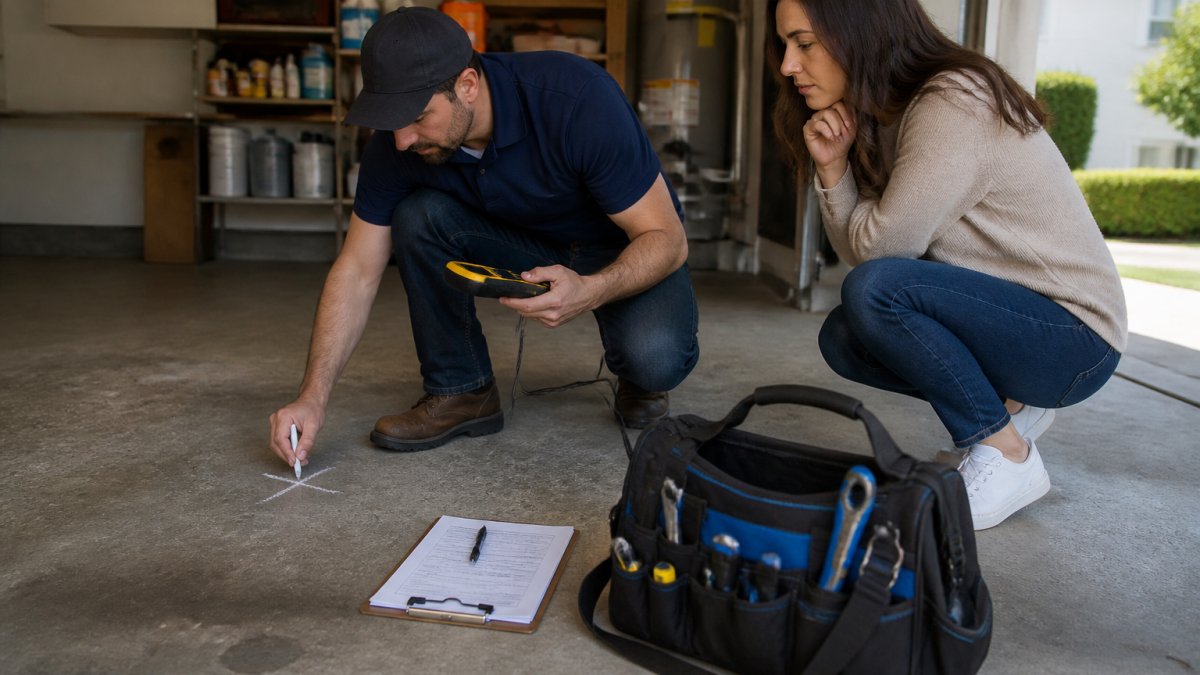
A common mistake is approving demolition on a verbal “it’s under the hallway.” Get the location written down, with the method used to find it. The water leak detection service should confirm the diagnosis before any slab is opened.
What a Slab Leak Repair Cost Calculator Can and Cannot Tell You
A slab leak repair cost calculator can give you a planning range. It cannot price your job. Online calculators work from averages: typical access depth, typical pipe length, typical restoration. Your house is not typical.
What they get right is relative weight. They show you that access and restoration usually outweigh the pipe work, which is genuinely useful when you are scanning a bid. What they get wrong is everything specific: whether your slab is post-tension, whether the leak sits under tile or carpet, whether a permit is required locally, and how far the water line runs from the meter.
Use a calculator to sanity-check the shape of a quote. Use the written estimate to judge the number.
Does Homeowners Insurance Cover Slab Leak Repair?
Homeowners insurance typically covers the resulting water damage, not the pipe repair itself. That distinction decides most claims. Policies commonly treat the failed pipe as maintenance and the soaked drywall, ruined flooring, and mold remediation as sudden accidental damage.
The practical move is documentation. Photograph the moisture, keep the detection report, and ask your adjuster directly which portion of the estimate is eligible. The Insurance Information Institute’s homeowner guidance explains how sudden versus gradual damage is generally treated. For the building-code side of restoration, the International Code Council publishes the model codes many jurisdictions adopt.
Nothing here replaces your policy language. Read the exclusions page before you assume coverage.
Warranties, Permits, and What the Estimate Leaves Out
Two things quietly missing from most estimates: the warranty and the permit.
Ask how long the workmanship guarantee runs, what it covers, and whether it survives if you sell the house. A warranty that covers labor but not materials, or expires in ninety days, is not much of a warranty.
Permits matter more than homeowners expect. Structural concrete work and plumbing alterations often require inspection, and an unpermitted repair can surface as a problem at resale. If a bid has no permit line, ask whether one is required for your scope. “We don’t bother” is an answer worth walking away from.
Comparing Two Estimates Without Getting Played
The lowest bid usually wins the job and loses the homeowner. Compare scope, not price. Two estimates for the same leak can differ by thousands simply because one includes restoration and the other quietly leaves it to you.
Line them up against the same checklist and ask three questions of each: What is excluded? Who pulls the permit? What is the warranty? Keep a list of red flags when hiring a plumber handy while you weigh the bids.
A second opinion is reasonable and often free at the estimate stage. You should not have to pay twice for diagnosis if you already hold a written detection report. Before you sign with anyone, run both bids against the checklist above.
Requesting a Written Estimate From Hydroworks Plumbing
The real test of an estimate is whether the contractor will put the scope, exclusions, and warranty in writing before asking for a signature. That is the standard we hold ourselves to.
Our licensed and insured team provides upfront cost information before work begins and offers 24/7 emergency service.
Frequently Asked Questions
How expensive is it to repair a slab leak?
There is no single figure, because a slab leak repair cost depends on the method, how deep the pipe sits, and what has to be opened up to reach it. A direct spot repair on an accessible line and a whole-house reroute sit at very different points on the scale. Ask for a written, line-item estimate that separates detection, labor, materials, concrete cutting, patching, and restoration so you can see exactly what drives the total.
What should a slab leak repair estimate include?
A complete estimate names the leak location and the method used to find it, the repair method proposed, labor hours and hourly rate, materials, concrete cutting and patching, flooring removal and restoration, permit and inspection fees where required, and the workmanship warranty term. It should also state exclusions in plain language. If a quote is a single lump sum with no breakdown, ask for the itemized version before signing anything.
Is rerouting a pipe cheaper than repairing it under the slab?
It can be, and often is when the leak sits under finished flooring or in a hard-to-reach spot. Rerouting runs a new water line through the attic or walls and abandons the buried section, which avoids concrete cutting and floor replacement. A spot repair costs less when access is simple. Compare both options on the same estimate, including restoration, before deciding which is the better value for your house.
Does homeowners insurance cover slab leak repair?
Most policies cover the resulting water damage, such as ruined flooring or drywall, but exclude the cost of repairing the pipe itself, which is treated as maintenance. Some policies add limited access coverage for the concrete breaking needed to reach the leak. Read your policy’s water damage and access exclusions, photograph everything before cleanup, and ask your adjuster in writing what is covered before you authorize work.
Can I get a second opinion without paying for another diagnosis?
Often yes. Ask the first plumber for the detection report, including pressure test results and the marked leak location, and share it with the second contractor. A reputable company will review that documentation and confirm or challenge the diagnosis rather than insist on a fresh detection fee. If a provider refuses to hand over the diagnosis records you paid for, treat that as a warning sign.
How urgent is a slab leak?
A slab leak will not fix itself and usually gets worse. Water running under a foundation can erode soil, shift the slab, and feed mold in flooring and baseboards, and the meter keeps spinning on your water bill. A hot spot or a sudden spike in usage means act now. A slow leak gives you a short window to gather two or three estimates, but do not let that window run for weeks.
If you are staring at a quote you cannot decode, or a floor that is warm underfoot and a water bill that will not settle down, get a second set of eyes on it. Hydroworks Plumbing provides accurate problem diagnosis, clear recommendations, and written estimates you can compare line by line. Get started with Hydroworks Plumbing and request a written slab leak repair estimate before anyone cuts concrete.